
The Cedar County Weekly Arrest-Report Layer
Cedar County posts no rolling arrest log covering three, seven, or ten days. The working substitute is newspaper coverage. The El Dorado Springs Sun Public Records archive groups its reports by date. It holds Sheriff and city police reports. The Cedar County Republican & Stockton Journal runs county news in its Wednesday editions. It also prints weekly Stockton Police Department activity summaries.
These weeklies answer a different question than the Arrests Last 24 Hours page. A current custody roster shows who is in the jail now. A weekly report shows what deputies and officers handled across a stated stretch. Expect arrests, warrants, calls, traffic stops, and totals. Not every item means someone was booked. Publication can lag the events by days.
Keep the two kinds of sources separate. A newspaper report is a dated account of agency activity, while JailTracker is the Sheriff-linked current-custody application. One person can show up in either one alone.
How to Read the Cedar County Police Blotter
There is no single "all arrests" list for Cedar County. Start instead from the likely agency and date, since that matches how the material actually gets published.
- Write down the approximate incident or arrest date, city, name spelling, and likely arresting agency.
- Search the Sun’s Public Records category for a Cedar County Sheriff report or El Dorado Springs Police Report covering that date. Open the article itself and verify its stated reporting window.
- For Stockton activity, check the Cedar County Republican’s Wednesday issue or e-edition. A weekly table’s covered dates and the issue date are not the same thing.
- Decide what kind of entry you found: a named arrest, a warrant event, an incident summary, or an aggregate activity count. Do not turn a category total into a list of individuals.
- Use the official Cedar County Sheriff page and its “Who is Currently in Jail” link only when the question is current detention.
- For the charge, docket, or disposition after arrest, follow the Cedar County Circuit Clerk link to Case.net or contact the clerk.
Write down the details that matter. Save the story title, the covered range, the publication date, and the URL. An agency case or booking number helps even more in a later records request than a remembered name.
Cedar County Sheriff Reports Cover Date Ranges
The format appears in context on the Sun's Cedar County Sheriff report page. It's a dated publication, not a live roster.
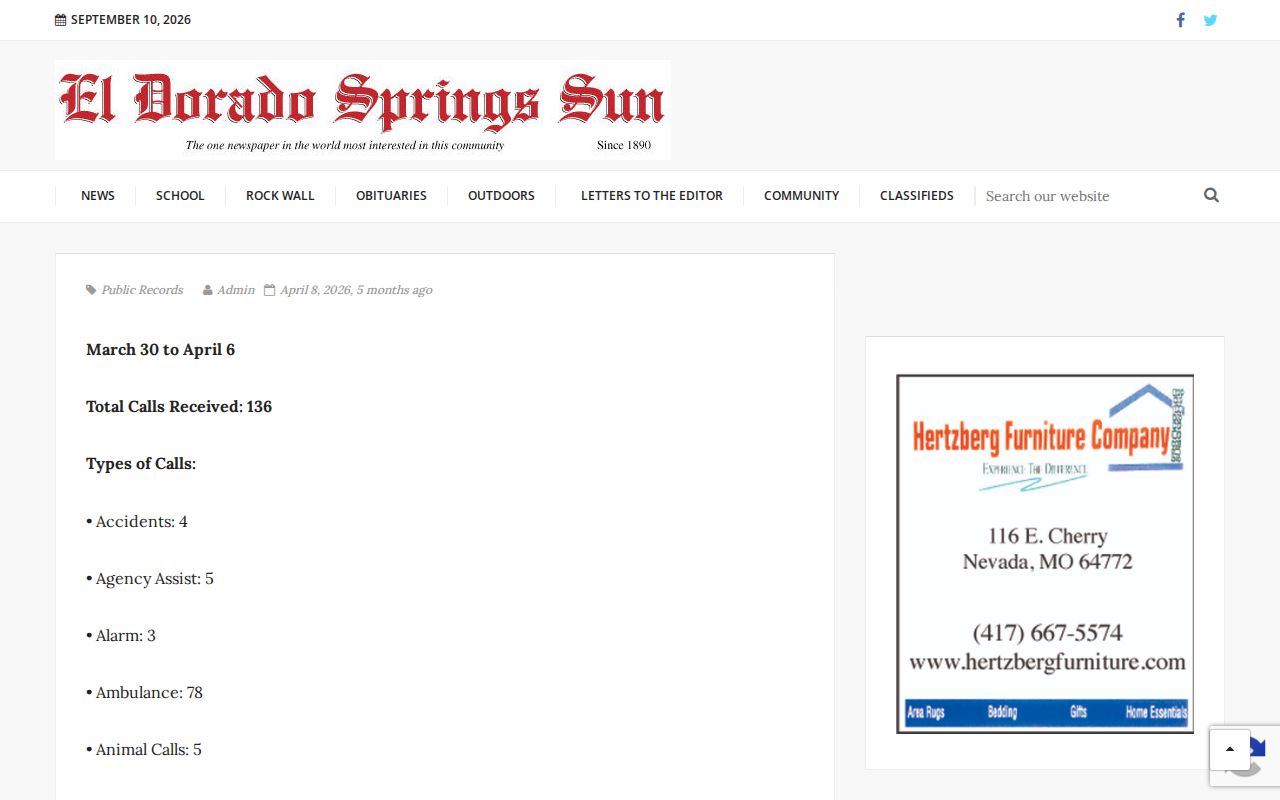
Sheriff reports usually state a covered range up front. They list call and incident categories plus enforcement totals. Some weeks add named incidents, warrant activity, charges, or arrests. The fields change week to week. Quote only what the article actually says. Not every reported call ends in an arrest.
An arrest in a Sheriff report does not mean the person is still confined. Bond release, transfer, summons, and later court action all run on their own timelines. Check the Sheriff-linked roster for current custody and the court record for how the case ends.
What a Cedar County Blotter Entry Can Show
Cedar County publications use narrative reports and activity tables rather than one standard booking card. Read each field according to its source.
| Report detail | What it establishes |
|---|---|
| Covered date range | The incidents summarized for that report; it may differ from the publication date. |
| Date, time, and location | When and where an officer response or reported event occurred, when supplied. |
| Agency and report type | Whether the item comes from the Sheriff, El Dorado Springs Police, Stockton Police, or another responding agency. |
| Name, warrant, or arrest reference | A reported enforcement event, not proof of guilt or necessarily current custody. |
| Charge description | The charge recorded at that stage; court filings and final disposition may differ. |
| Category and count | An aggregate measure such as traffic stops, disturbances, or warrants, not a person-level booking list. |
| Photograph | An article-specific editorial element. Neither newspaper promises a photo for every arrest. |
The Sun's web reports carry no booking photos. Some Republican crime stories have used black-and-white or contributed photographs from bookings. That does not add up to a uniform jail photo policy. Nothing here rehosts pictures of arrested people.
El Dorado Springs Police Reports Add City Detail
The Sun's city police reports add street-level detail. A county roster lacks that. One example covers July 30 through August 5, 2026. It lists dates, locations, and report types, with occasional arrest, warrant, or charge notes. Some people held after city arrests are transferred to the Cedar County Jail. Record the arresting agency and the holding facility separately. The El Dorado Springs Police Report shows that recurring format.
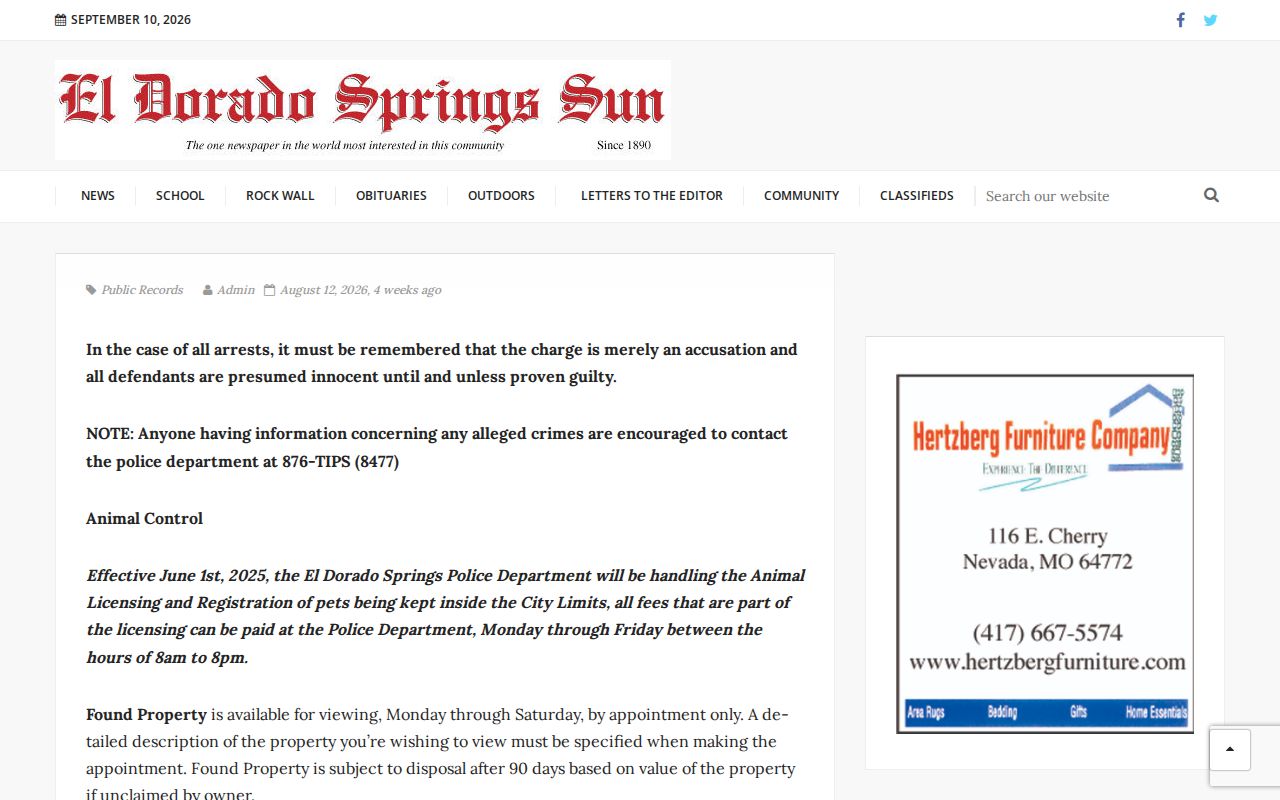
The example helps you recognize the layout. It marks the exact date window the report covers. Save the URL rather than an undated screenshot when you share it.
Stockton’s Police Blotter Is an Activity Table
The Cedar County Republican's November 26, 2025 issue carries a Stockton Police Department report for November 14 through 20. The week is broken into categories with counts. Traffic stops, summonses, suspicious people or vehicles, alarms, and intoxication each get their own line. So do crashes, welfare and medical calls, drug activity, property reports, theft, fraud, agency assistance, warrants, follow-up, disturbances, domestic calls, assault, juvenile calls, nuisance or animal calls, and a calls-for-service total.
That table measures police workload. It is not a row-by-row booking log. A number under "warrants" should not become unnamed suspects. A calls-for-service total is not an arrest count either. The issue lands each Wednesday, after the covered week ends. The PDF is linked here rather than shown.
Weekend Arrests and Publication Delay
Cedar County newspapers run on weekly cycles. A Friday-night arrest or a holiday-weekend booking may sit unpublished until the next edition comes out. There is no promised weekend update for JailTracker either. That gap catches people off guard. So work from the date of the event, not the date on the article. Pull the report whose covered range includes that day, even if the paper dated it later. A missing entry proves nothing about whether an arrest happened. The item may simply have missed the editor's cut. It may have belonged to another agency, ended in a summons with no county detention, hit a records restriction, or shown up in a later report range. Need current custody status? Call the Cedar County Sheriff's Office at 417-276-5133, extension 251. For a named record, the Cedar County arrest-record guide plus a focused Sunshine request is the stronger path.
JailTracker Outages Change the Research Order
The sheriff's official link opens a Public Safety Cloud/JailTracker application. It sometimes loads its shell. Then it throws an unhandled error instead of results. The software itself handles booking data, charges, bonds, court dates, holds, releases, and booking images. A failed result view tells you nothing about which fields are actually public right now. That reality shapes the order of operations in Cedar County. Try the roster first. Then call. Then file a request if you need paperwork. While the roster is down, the weekly blotter still documents past agency activity. It cannot tell you whether someone is still in custody, though. For that, call the Sheriff directly. Ask the records custodian for a booking report when you need documentation. Then turn to the court for everything after booking.
Finding Older Cedar County Arrest Reports
Older Cedar County arrest reports take patience, but several trails exist. The Sun's public records category keeps many weeks of searchable web material. Cedar County Republican issues and their PDF links offer another date-based route. Retention is never promised. So write down issue dates and headlines while you can still find them. For the long haul, the State Historical Society of Missouri Cedar County newspaper directory is a strong resource. It tracks holdings, microfilm reels, and online access guidance. Want an official arrest or booking file from years back? Start with the Sheriff, not the newspaper archive. Missouri's Secretary of State sheriff schedule puts this material under SHF 006. That category covers arrest logs, arrest files and registers, fingerprints, booking sheets, and similar identifying information. It carries a five-year minimum retention period. That minimum promises nothing about five years online. Nor does it mean a specific file was destroyed once five years passed. Litigation, a pending case, repository rules, or plain local policy can all extend or complicate what actually survives.
- Collect the full name, approximate date, agency, known number, and the exact article or source.
- Ask the Sheriff whether the booking report and photograph remain locally held and who is custodian.
- Check the Circuit Clerk and Case.net for the court case and disposition.
- Search the Sun and Republican by the report period and publication date.
- Use historical archives only when their described record type and date fit. They are not modern name-indexed jail rosters.
Confirm Every Cedar County Arrest at Its Source
Local reporting adds a durable, multi-day layer of detail, but verification still runs through the originating agency and the court. Each source covers a different slice of the truth. A booking record shows intake into the jail. A weekly police item reports an event. A roster shows who is listed in custody right now. A court docket tracks what happened afterward. None of them can stand in for all the others. Treat absence from any single archive with caution too, since an arrest can exist without leaving a mark in the place you happened to check.
Public Record Search
Sponsored Results